Other Publications
Below you will find descriptions and links to some of my other publications. For a complete list, see my vita.
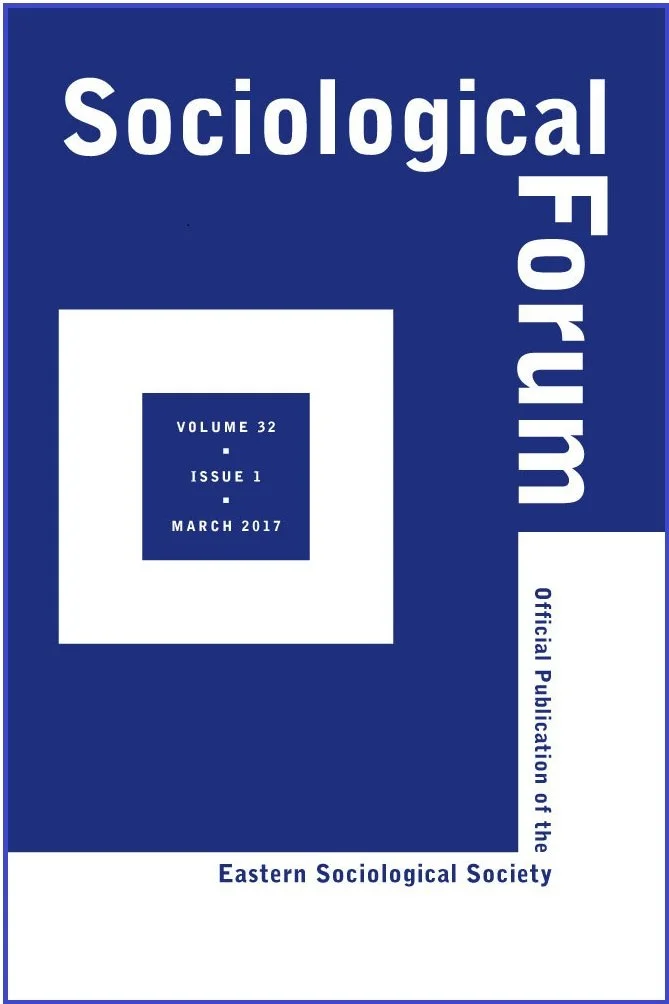
“Which Side Are the Faculty on?: Professors, the 2019–2020 Democratic Presidential Primary, and the Politics of Redistribution in the United States”
Sociological Forum. December 2025.
Popular discourse often stereotypes U.S. professors as extreme leftists. My analysis of campaign contributions made by faculty during the 2019-20 Democratic Party presidential primary calls such stereotypes into question. In fact, when it comes to economic issues, Americans outside the academy appear to have more radically left views than those working within the ivory tower. Researchers can access the data underlying the article’s analysis by visiting my data repository.
“ ‘¡Olimpiada Sí! ¡Represión No!’: The Mexican Student Movement and the 1968 Olympic Games on Display”
Journal of Olympic Studies. Vol. 5, no. 2 (Fall 2024): 113-121.
This essay reviews the M68 exhibit at the Centro Cultural Universitario in Mexico City’s Tlatelolco area. M68 chronicles the Mexican student movement in the months leading up to the infamous massacre of protesters in Tlatelolco plaza in October 1968, just weeks before the the beginning of the XIX Olympiad in Mexico City. My review focuses on the exhibit’s treatment of how student activists used the impending Games to highlight the contradictions between the Olympic movement’s alleged commitment to peace and the government’s repression of protest.


“Michael Jordan at the 1988 Slam Dunk Contest: Liftoff for the NBA and Nike in the New Gilded Age”
This book chapter uses the iconic photograph of Michael Jordan’s title-clinching attempt at the 1988 National Basketball Association (NBA) Slam Dunk Contest as a lens into the economic history of the league at the end of the twentieth century. The photo encapsulates several ways in which the NBA adapted to the rise of neoliberalism, such as the cultivation of clean-cut superstars to market the sport more globally and cater to more affluent spectators.
“The ‘spirit of revolt’: A reappraisal of black veterans in chicago’s red summer”
Journal of Urban History. Published “Online First” November 2024.
This article, co-authored with my late friend Chris Lamberti, is a deep dive into the role that African American World War I veterans played in defending their neighborhoods during the Chicago Race Riot of 1919. Readers can visit my data repository for open access to the data used to create the article’s maps.

“Juking the stats: why the nba finals won’t be a godsend for the economies of denver and miami”
I wrote for Counterpunch‘s online magazine on the widespread, yet mostly unfounded, claims the the 2023 NBA Finals will prove an economic boon to Denver and Miami. While they fail to properly inform, stories trumpeting such arguments provide cover to publicly subsidized sports teams. If for no other reason, check it out for the incontinence joke!
“The history that explains why a democratic socialist may be Buffalo's next mayor”
Washington Post, November 21, 2021.
Derek Seidman and I co-authored a piece for the Washington Post’s “Made by History” section on the history that explains why democratic socialist India Walton is on the cusp of becoming the next mayor of Buffalo. We argue that Walton has tapped into the mounting discontent in America's cities, especially residents’ frustration with over half a century of urban revitalization initiatives have failed to combat the social and economic consequences of deindustrialization.
“beginning with the braves: milwaukee and stadium development in the postwar american city”
Reviews in American History. Vol. 48, no. 2 (June 2020): 305-310.
Patrick Steele’s Home of the Braves chronicles the relocation of Major League Baseball’s Braves from Boston to Milwaukee in 1953, the team’s brief tenure in the Brew City, and its subsequent move to Atlanta in the 1966. This review examines how Steele’s book adds to our understanding of the evolution of the sports business after World War II and, in particular, how the Braves’ played a seminal role in major-league teams playing cities off one another to extract more public subsidies from them.
“Digging Deeper into the dodgers”
Journal of Urban History. Published “online first” June 2020.
This review essay examines a quartet of recently published books offering new insights into the history of the L.A. Dodgers’ migration from Brooklyn to Southern California, as well as the urban history of Chavez Ravine and Dodger Stadium. The books under review significantly expand our understanding of the causes and consequences of franchise relocation in the post-World War II era.


“Sport and blue-collar mythology in neoliberal chicago”
In recent years, sportswriters in Rustbelt cities like Chicago have increasingly used the label “blue-collar” to describe millionaire athletes. This chapter, co-authored with my late colleague Christopher Lamberti and part of a larger collection entitled Neoliberal Chicago, argues that this trend exemplifies the growing investment of mainstream media in definitions of “class” that emphasize style over income, wealth, and job category; and by extension distract from growing inequality in the U.S.
“The Attrition of the Common Fan: Class, Spectatorship, and Major League Stadiums in Postwar America”
Social Science History. Vol. 40. No. 2. Summer 2016. Pages 339-365.
This article uses an original data set tracking changes in major-league stadium size and seating arrangements since World War II to demonstrate the recent trend toward extreme stadium gentrification. Basically, it is a more in-depth, academic version of the Jacobin piece referenced below. You can access the data underlying the statistics cited in the piece by visiting my data repository.


“fanfare without the fans”
Jacobin Magazine (“Paint the Town Red” issue). Fall 2014.
This article describes how major-league sports teams have, in recent decades, made their venues less accessible for working- and middle-class fans in order to maximize profits. Trends such as dramatic expansion of luxury suite and “club” sections at the expense of affordable seating are evident across leagues and cities. Despite catering to a much narrower slice of the population, new stadiums continue to benefit from generous public subsidies. You can access the data underlying the statistics cited in the piece by visiting my data repository.
Film Review of ted woods’ white wash
Journal of Sport History 39, no. 3 (Fall 2012): 532 — 534.
This review examines the 2011 documentary film White Wash, in which director Ted Woods delves into the history and sociology of African American surfing. Viewers may also consider watching a Wade in the Water: A Journey into Black Surfing and Aquatic Culture, a more recent effort to address the same topic.
